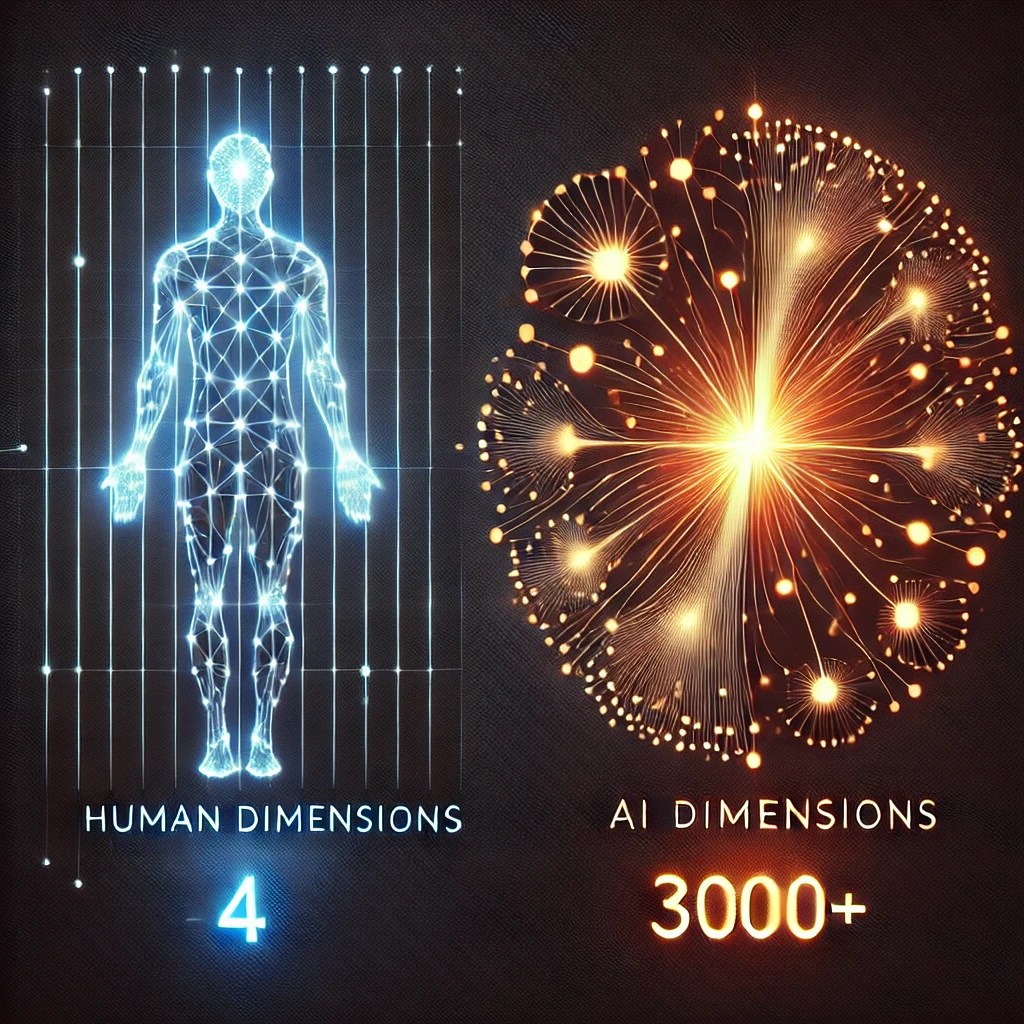
AI virtually operates in 3,000+ dimensions. Humans, however, navigate within 4 dimensions—space and time—and the limitless potential of our mental dimensions.
As computing becomes increasingly pervasive, the overlap between what humans and AI can achieve continues to grow. This evolution isn’t (hopefully) about competition but collaboration—where human creativity meets AI’s precision, unlocking extraordinary possibilities together.
Humans and AI operate in unique ways, shaped by the dimensions they navigate. Humans naturally function in 4 dimensions (X, Y, Z, and Time), while AI processes information across thousands of dimensions simultaneously. Let’s dive into how they compare.
The Dimensions (of Intelligence ??):
| Entity | Number of Dimensions | Description |
|---|---|---|
| Humans | 4 (X, Y, Z + Time) | Navigate space and time with sensory, emotional, and cognitive abilities. |
| AI | 3,000+ | Analyze massive data across multidimensional spaces to find patterns and solutions. |
To better illustrate the difference in dimensionality, refer to the visual comparison below:

This chart highlights the vast gap in the number of dimensions humans and AI process, showcasing AI’s ability to operate in highly complex data spaces.
AI and Human Intelligence: A Side-by-Side View
| Dimension | Human Capability | AI Capability |
|---|---|---|
| Learning | Experience and memory | Learns patterns from huge datasets. |
| Reasoning | Logical thinking, emotions and intuition | Uses algorithms for decision-making. |
| Perception | Seeing, hearing, and feeling | Relies on tools like cameras and sensors. |
| Interaction | Emotional and verbal cues | Communicates using Natural Language Processing. |
| Autonomy | Intuitive and learned decisions | Acts independently using programmed logic. |
Humans and AI: A Perfect Pair
Humans excel at creativity, empathy, and intuition, while AI processes vast amounts of data with speed and precision. Together, they complement each other—AI handles complex, high-dimensional tasks, while humans guide its purpose with emotional and contextual understanding.





Leave a comment